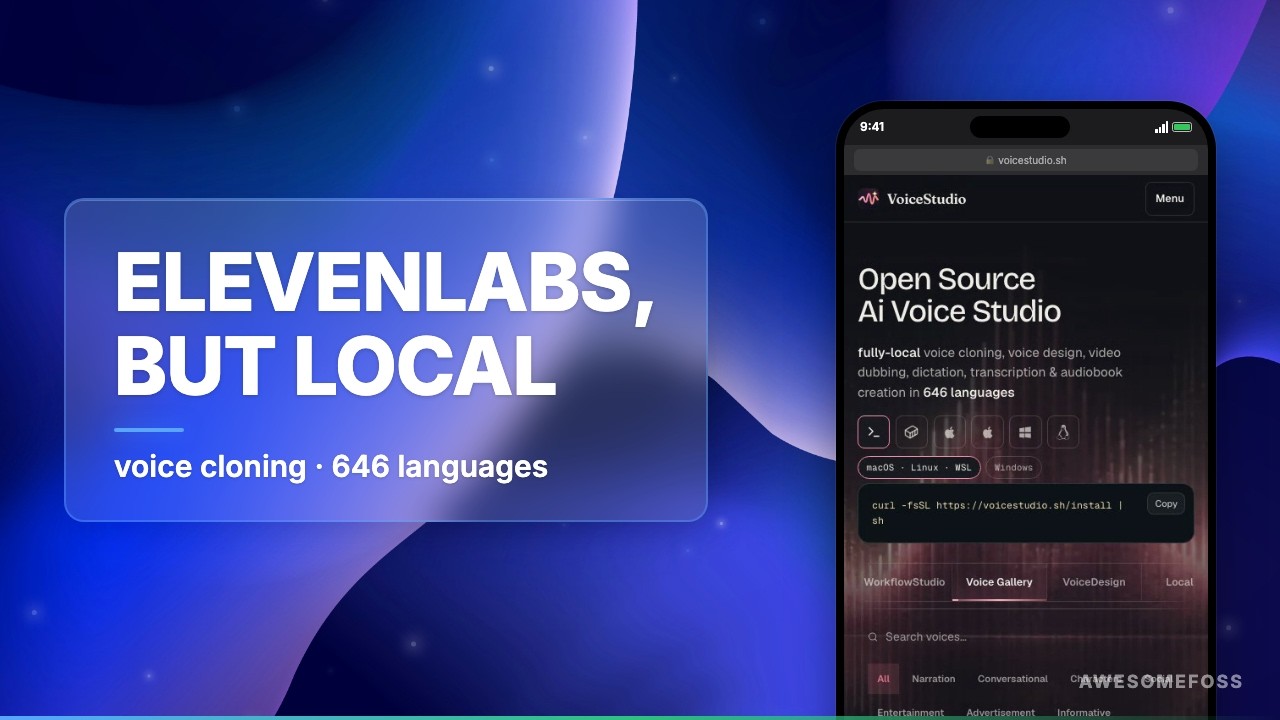
🎙️ What VoiceStudio Is 0:00
VoiceStudio 🔗 is the open-source, fully-local ElevenLabs alternative. The feature list reads like the ElevenLabs wall reproduced locally: voice cloning from a 3-second sample, voice design from a written description, video dubbing that preserves who's speaking, dictation, transcription, and audiobook production — across a 646-language catalog, on your own hardware, with "no account, no API key, no subscription, and no usage meter."
The framing that lands hardest comes at the end of the video: "The most personal biometric you own just became something you can synthesize at home." A voice is arguably the most identifying thing a person has — and VoiceStudio's entire pitch is that this can now happen without any of it leaving your machine.
⚙️ A Workbench Over 27 Engines 0:32
The architectural trick is what makes it more than "another TTS app": VoiceStudio isn't one model, it's a workbench over 16 TTS engines and 11 speech-recognition engines, with a model catalog that downloads and manages them for you. You can switch engines straight from the status bar while generation keeps running.
The builder is Palash Debnath, a serial builder from India with over 1,700 commits on this repo since April and a portfolio eight projects deep. VoiceStudio — previously named Omni Voice Studio, the old name still echoing around the internet — is the one that caught fire, riding TrendingShift's rankings and pulling in community contributors.
🚀 14,471 Stars in 5 Months 1:31
The growth curve is the video's headline: 14,471 stars since the repo appeared on April 9th — five months — plus over 2,000 forks and 279,000 downloads through GitHub releases alone, before counting Docker. That star count puts a 5-month-old audio tool "ahead of projects that have been building for years."
The stat that impressed the host most was the health signal: just 7 open issues at 14,000 stars — "a maintainer keeping pace with a viral audience." The release rhythm backs it up: 37 releases in 5 months, better than one-and-a-half a week, through 0.4.x, then 0.5.0 on August 14th (the engine quick-switcher) and 0.5.1 on August 28th. The version numbers stay humble — the project labels itself an "active beta" and means it.
🎬 The Workflows 2:02
The workflow list covers the full ElevenLabs surface:
| Workflow | What it does |
|---|---|
| Voice cloning | 3 seconds of clean audio works; 5–15s is better; zero-shot, no training run |
| Voice design | Describe age, accent, pitch, and delivery in words — get a matching voice |
| Video dubbing | Transcribe, translate, keep each speaker distinct, synthesize, export |
| Stories & audiobooks | Multi-voice scripts, EPUB/PDF import, chapter rendering, .m4b export |
| Dictation | System-wide widget, live transcription, optional local-LLM cleanup of ums/ahs |
The 646-language catalog gets an honest footnote: coverage and quality vary by engine, and the README says so itself — "exactly the right way to make that claim." Install is either a one-liner from the website or a plain desktop package (Apple Silicon DMG, Windows MSI with a no-admin option, Linux AppImage, or Docker images with CUDA/ROCm/CPU/worker-only-GPU profiles). First launch builds a managed Python environment and pulls the default model; after that it's "an app like any other." Compute-wise it meets you where you are — CUDA, Apple MPS/MLX, AMD ROCm, plain CPU, or a remote GPU worker — and ships a built-in diagnostic plus a scrubbed bundle exporter for bug reports, "support tooling most beta projects never bother building."
🏠 Local vs ElevenLabs, and a Server Too 3:42
The comparison is framed as a trade, not a takedown. ElevenLabs is the polished cloud standard — best-in-class quality, an API business, and "a meter running on every character." VoiceStudio's trade is different: your audio never leaves the machine, there's nothing to subscribe to, and the engine roster updates as open models improve. Cloud still wins on peak voice quality for the hardest material and zero hardware requirements; local wins on privacy, price, offline use, and unlimited volume. "For a lot of workloads, local just became good enough."
For builders, it's quietly a local audio API server: REST, server-sent events, and WebSocket endpoints, plus an OpenAI-compatible audio API — point any tool that speaks the OpenAI speech format at localhost and it just works. There's an MCP server too, so Claude or any MCP-compatible agent can drive synthesis and transcription directly, with batch generation for the "produce 100 clips" crowd. If you already script against OpenAI's speech endpoint, migration is a base-URL swap.
⚠️ The Honest Context 6:02
The video closes with the four-part "honest context" that separates a real review from a hype piece:
That last point is the moral of the whole video: the most personal biometric you own just became something you can synthesize at home — "and the version that respects that is the one where nothing leaves your machine."
💡 Key Takeaways
- It's a workbench, not a model. 16 TTS + 11 ASR engines behind one app, with a catalog that turns new open voice models into menu items instead of migrations.
- Fully local by design. No account, no API key, no subscription, no usage meter — your voice never leaves the machine.
- The full ElevenLabs feature wall, reproduced. Cloning, voice design, dubbing, dictation, and EPUB/PDF-to-audiobook across a 646-language catalog.
- It doubles as a server. REST/SSE/WebSocket, an OpenAI-compatible audio API, and an MCP server — migration from OpenAI's speech endpoint is a base-URL swap.
- AGPL-3.0 and dual-use. Build a service on it and you owe changes back; clone only your own voice or with consent — local doesn't change the law or the ethics.
- Hardware is the real requirement. Apple Silicon or a GPU, or expect patience; Intel Macs can't run the local backend at all.
🔗 Resources & Links
- 📦 github.com/debpalash/VoiceStudio — the repo (AGPL-3.0)
- 🌐 voicestudio.sh — website & one-line installer
Source video: youtube.com/watch?v=WbBXg430K9A